Como foram construídas as Grandes Pirâmides? | Mito das Pirâmides
Como foram construídas as Grandes Pirâmides?
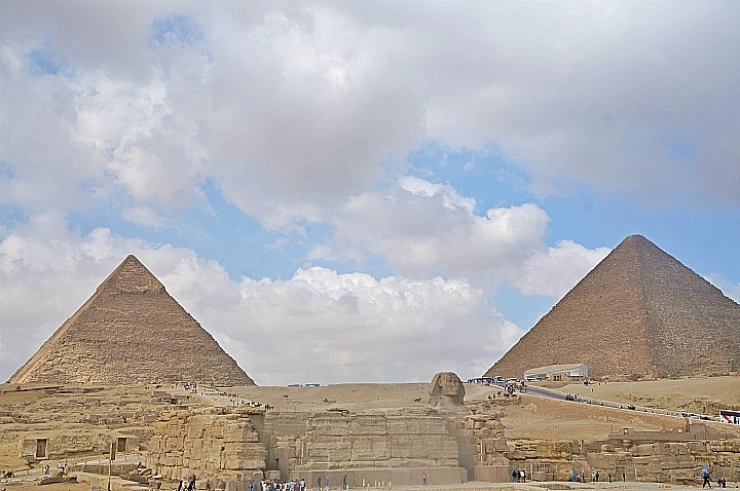
Neste artigo, vamos mostrar-lhe como foram construídas as Pirâmides de Gizé?
Os antigos egípcios utilizaram um grande número de mão-de-obra na construção das pirâmides participaram na construção da Pirâmide de Quéops que remonta à 4ª dinastia durante a história do antigo reino do antigo Egipto e que se situava em Giza entre 20.000 a 30.000 homens, que durou cerca de 23 anos, Note-se que não foram os escravos que participaram na sua construção, mas aqueles que participaram na sua construção são livres, foram isentos do pagamento de impostos, além de lhes dar roupas, habitação e comida grátis, receberam tudo isso em reconhecimento dos seus esforços, e para os encorajar a continuar o seu trabalho sem interrupção.
Mito das Pirâmides
Os trabalhadores utilizaram uma variedade de ferramentas para cortar os blocos utilizados na construção das pirâmides, incluindo martelos de granito, e cinzéis de cobre. Construindo através da areia com a ajuda de grandes trenós de madeira, são puxados sobre a areia molhada, o que reduz a força de arrastamento para metade.
Os construtores da pirâmide construíram escadas de tijolos de lama e depois cobriram-nas com lascas de cera para endurecer a sua superfície, de modo a poderem puxar as pedras até chegarem ao seu lugar exacto na pirâmide, e depois repetiram esses passos de cada vez que subiam.
pudemos evidentemente provar este método como uma razão para ver este tipo de rampa no topo do primeiro pilão no Templo de Karnak, visitado durante as excursões do dia de Luxor e do dia de Assuão e uma pirâmide inacabada remonta ao antigo reino da História do Egipto.
reinado de Djedefre.
Pode desfrutar de uma Excursão às Pirâmides de Gizé e ao Museu Egípcio ou pode combinar uma Excursão de Dia do Cairo às Pirâmides de Gizé, Esfinge, Memphis, Sakkara, e Dahshur. A Grande Esfinge em Gizé também pode ser vista através de uma Excursão de Trânsito de escala do Cairo, Cairo City Break, ou mesmo se tiver uma Excursão de escala do Cairo pode espremer a sua Excursão do Aeroporto do Cairo para uma Excursão às Pirâmides de Gizé e à Esfinge Half Day Tour com
Passeio de Camelo.
How were the pyramids built step by step
The Construction Mechanisms of the Pyramids: Estimating the Engineering Feats of the Ancient Egyptians
The Giza Pyramids are some of the greatest buildings that were ever designed and built, and the workforce that existed in those days was just extraordinary and incredible. These massive structures, particularly the Giza period pyramid, have puzzled historians, archeologists, and engineers for many ages, imbued with the perennial query of how such structures were even raised in the first place. These constricting structures were lifted by ancient people exercising modern-day power, construction engineering, and most fundamentally, physics and material science.
In this paper, let us specifically deal with the Giza Pyramids, their construction and techniques that were employed, the tools brought in, and the people present in the country.
Who built the pyramids?
The Workforce Behind the Pyramids: Myth vs. Reality
A widely held belief that the Pyramids were built by slaves has been proven to be false by recent studies. The Great Pyramid of Cheops (Khufu), which was constructed within the fourth dynasty of Old Kingdom Egypt, was constructed by skilled laborers and not by slaves. Estimates have suggested that between 20,000 and 30,000 men took part in the construction work, and this lasted about twenty-three years.
Rather than being enslaved, these workers received proper payments for their work. More so, they were also given accommodation, food, and clothing in return for their services, which included a tax waiver. These were aimed at ensuring that they took part actively in the building of the pyramid for as long as it took and appreciating their input.
How were the pyramids built so accurately
Instruments and Components
The builders of the pyramids may have had a whole arsenal of cutting and measuring tools to cut and shape the large die stones, which are the building blocks of the pyramids. However, while the shell of most pyramids was built of limestone, the core of these structures was more advanced materials, especially granite, which required more sophisticated tools. There was a granite hammer to first carefully shape the rock statues, a few basic copper chisels, and other items that were quite artistic with stone engraving.
One of the main challenges in the process of building the pyramids was that they not only had to be built, but there were massive stone slabs to be carried, which weighed about 15 tons each, among others. It is believed that the ancients would use wooden sleds and load the stone blocks on them and then drag the blocks over the sand. Watering the sand ahead of the sleds was another technique since this reduced the resistance to pulling the stones. Studies revealed that this method of wetting the sand can help reduce the force of pulling by as much as fifty percent, making it very convenient to move heavy stone blocks.
How were ramps used to build pyramids
The Use of Ramps in Pyramid Construction
One of the most fascinating techniques that the Egyptians used in the construction of the pyramids was the application of ramps. Workers made use of rampways made of mud bricks with a coating of wax chips to enhance the durability of the surface. These ramps enabled the workers to pull the heavy stone blocks to the higher levels of the pyramid and, more so, to position them correctly.
This process would be repeated layer after layer of stones until the pyramid reached its full height, with additional ramps being constructed to enable the lifting of stones. These ramps played an important role in the whole process of construction, and remains of such ramps have been discovered in other parts of Egypt, including temples like the Karnak Temple in Luxor and an incomplete pyramid from the period of Djedefre, both from the Old Kingdom.
The historical ramps' construction principles have neither been agreed upon nor dismissed by historians and engineers. Some contend straight “runners” could be built on one face of the pyramid; others contend a more complicated set of systems, including zigzag-forming runners or even runners that wrapped around the pyramid. In whatever shape, designed, and built, these ramps were major for moving the heavy stone blocks to the more elevated sections of the pyramid.
Mastering the Pyramid Shape
The most interesting thing about the Giza Pyramids is the way they were built perfectly, and their alignment was unquestionable. The Great Pyramid has its sides aligned to face the four cardinal points of the compass with unimaginable precision, a task that would be beyond someone who didn’t understand geometry and astronomy at an advanced level.
To avoid the bulging of the pyramid while building it, the ancient Egyptians probably made use of various measuring devices like plumb lines and set squares. The sharpness of the design is illustrated by the almost equal size of the base and the extreme rise of
the sides of the pyramid, which remain unchanging even at higher levels.
For many centuries, the successful execution of this alignment has been a subject of admiration and wonder. The angles are strikingly accurate, and the mathematical proportions of the construction allow one to understand why the ancient Egyptians were geometry masters and how to build from the bottom of the pyramid to its peak while preserving its shape.








-webp.webp)